
Organic farmer Asami’s wife and daughters evacuated in March 2011 from Aizu, 130 km west of the Fukushima Daiichi Nuclear Power Plant. Asami only saw his daughters a few times last year. In the winter, the family moved back to Aizu.

A documentary series about Fukushima farmers fighting to continue growing organic food on land contaminated by nuclear fallout


Organic farmer Asami’s wife and daughters evacuated in March 2011 from Aizu, 130 km west of the Fukushima Daiichi Nuclear Power Plant. Asami only saw his daughters a few times last year. In the winter, the family moved back to Aizu.
Today Uncanny Terrain codirector Junko Kajino begins an East Coast mini-tour, presenting scenes from the in-progress documentary for schools and community groups. Please join her if you’re in the area.
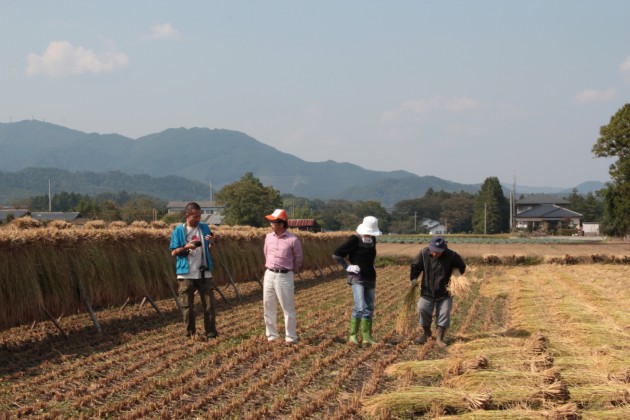 Filmmakers Junko Kajino and Ed M. Koziarski spent five months inside Japan’s nuclear contamination zone for our documentary Uncanny Terrain – living and working with the farmers, researchers and volunteers who have committed themselves to take the nuclear crisis as an opportunity to build a better society. We’re going beyond disaster reporting, to show what it is really like for these people who refuse to bow to devastating odds.
Now we need your help to return to Japan and revisit those working on the front lines of the nuclear crisis, as they mark the one-year anniversary and the farmers prepare to plant again.
 We need to raise $10,000 by March 31 to cover the cost of traveling to Japan and shooting there through the April planting. Please join us by donating to and sharing our new IndieGoGo campaign. We encourage PayPal contributions because they are tax-deductible, and funds are available to us immediately. Thank you to everyone who has already supported Uncanny Terrain. Please send this invitation to your friends. Join the campaign on Facebook.
 The organic farmers of Fukushima prefecture toiled for 40 years to grow safe, nutritious and delicious crops on their ancestral land while two nuclear power plants in the prefecture helped feed Tokyo’s increasingly voracious energy appetite.
Since the March 2011 tsunami triggered the meltdown that spread radioactive contamination on much of the lush farmland of Fukushima and eastern Japan, the farmers have been caught between a government in constant denial of the risks of radiation, and outraged citizens who brand the farmers “child murderers” for continuing to cultivate irradiated land.
 But the farmers, researchers and volunteers are committed to building a comprehensive monitoring and reporting network to inform citizens about contamination levels in food, air, water and land, so families can make their own informed decisions; and advancing experimental methods to decontaminate soil or prevent crops grown on contaminated soil from absorbing radiation.
Fukushima has demonstrated the need for greater public vigilance to keep all our food and energy producers honest, not just about radiation but about all the potential contaminants that our collective appetites introduce into our bodies and our communities.
Please support Uncanny Terrain and help generate dialogue about these vital issues and assure that the struggles of people in Fukushima can stimulate positive change in the world. Thank you!

by Sam Worley
Chicago Reader
Along with Junko Kajino, occasional Reader contributor Ed M. Koziarski is codirector of Uncanny Terrain, a documentary about effects from last year’s tsunami and nuclear crisis on Japan’s rice farmers. This preview screening event includes music by Tatsu Aoki and his band the Miyumi Project, and David Tanimura shows digital collages about the nuclear threat. RSVP required; e-mail uncannyterrain@gmail.com.
This is video we shot of the December performance at the Museum of Contemporary Art Chicago by Uncanny Terrain composer Tatsu Aoki‘s group Tsukasa Taiko Legacy at JASC.
Tatsu and his band The MIYUMI Project will accompany preview scenes from Uncanny Terrain with their fusion of jazz and Japanese classical music from 6-7 p.m. at High Concept Laboratories‘ benefit reception this Sunday, Feb. 5, 5-8 p.m. at 1401 W. Wabansia in Chicago.
 Featuring art by David Tanimura, sushi by Chef Atsushi Iwamoto of Mizu Yakitori (thanks to Mayumi Miyazaki and Asako Hoichi), organic Daishichi Sake courtesy of JFC International, kurimanju and inarizushi by Jo Anne Yamamoto of Auntie Jo’s Yummies, and appetizers courtesy of Shino Tamura from Murasaki Saki Lounge.
All this for no cover charge! But a portion of art sales and all donations benefit our return to Japan in March to capture the first anniversary of the earthquake, tsunami and meltdown. If you’re coming, be sure to rsvp here or here.
Can’t miss the first half of the Superbowl? Not in Chicago? We still invite you to make a tax-deductible donation to fund the completion of the film.
Make checks payable to our new fiscal sponsor, Asian Improv aRts Midwest (AIRMW), c/o Japanese American Service Committee, 4427 N. Clark, Chicago, IL 60640 (memo: Uncanny Terrain).
And we continue to accept online donations through our ongoing fiscal sponsor Ionia Inc.
 Uncanny Terrain has been awarded a grant from the Illinois Arts Council‘s Individual Artist Support fund for media arts. Thanks!

by Ed M. Koziarski
North Avenue Magazine
Jan. 28, 2012
When does a victim become a perpetrator? That’s the question that kept coming up as we made our way across the irradiated landscape.
Many foreigners fled Japan after the tsunami triggered a meltdown at the Fukushima Daiichi Nuclear Power Plant last March. My wife Junko Kajino and I went the opposite way, spending five months inside the U.S.-declared 50-mile no-go radius for our in-progress documentary Uncanny Terrain.
 By Jake Malooley
TimeOut Chicago
Jan. 25, 2012
One steamy day last July, Junko Kajino and Ed M. Koziarski found themselves in Fukushima, Japan, hiding beneath a tarp in the back of a pickup truck full of cow feed. The farmer behind the wheel smuggled the filmmakers into a government-mandated 20-kilometer evacuation zone that became highly contaminated with radioactive cesium after a massive earthquake 43 miles off the city’s coast in March. The quake triggered tsunami waves that smashed into the Fukushima Daiichi Nuclear Power Plant, causing meltdowns of three reactors.
Filmmakers Junko Kajino and Ed M. Koziarski talk about making the documentary Uncanny Terrain, about organic farmers facing Japan’s nuclear crisis. http://tinyurl.com/uncannyterrain
Fukushima farmers’ rice harvest sits in stockpiles, mostly unsold after radioactive cesium was detected in samples in and outside of the prefecture.
Unable to sell their rice, Fukushima organic farmers have become educators, promoting understanding among their customers about the interconnections of land use, energy consumption, and traditional culture.
Despite staggering odds, most of the farmers remain committed to preserving and recovering their land for future generations.
We return to Fukushima this March to capture the recovery efforts a year after the 3/11 tsunami, earthquake and nuclear disaster.
 To support this endeavor, nonprofit arts support organization High Concept Laboratories presents Fukushima: 1 Year After the Meltdown, a benefit reception for Uncanny Terrain, Sunday, Feb. 5, 5-8 p.m. at 1401 W. Wabansia in Chicago.
 From 6-7 p.m. we’ll screen a preview video with live accompaniment by our composer Tatsu Aoki and his band The MIYUMI Project, which performs a fusion of jazz and Japanese classical music.
Tatsu is a jazz bassist and a leader of the Chicago Asian American Jazz Festival and Tsukasa Taiko Legacy.
 David Tanimura will showcase his digital collages inspired by the nuclear crisis. Refreshments will be served. The reception is free but rsvp is required, and tax-deductible donations to the film are welcome.
Not in Chicago? Can’t make it? Want to help today? We continue to gratefully accept online tax-deductible donations in support of Uncanny Terrain.


Just as the U.S. State Department announces that it’s safe to be here, it’s time for us to leave. We conclude our 20 weeks living and working among the organic farmers and food producers of Fukushima, a week after the State Department narrowed its travel advisory against visiting the area around the power plant from 80 kilometers to the Japanese government’s 20-kilometer evacuation zone.
Seven months since the beginning of the crisis, Japan stumbles toward recovery. Evacuated communities are being reopened near the nuclear plant, even as many efforts to decontaminate land are proving ineffective. With a number of notable exceptions, testing of rice and vegetables is showing much less contamination than was expected based on results in Chernobyl. Researchers investigate the reasons for these levels, considering the differing composition of Japanese soil, particularly certain minerals and bacteria that may remove radioactive cesium or prevent plants from absorbing it—bacteria that may thrive in organically cultivated land.
But the food testing regime is still sporadic, and no amount of lower test results will be sufficient to convince much of the public that Fukushima food is safe to eat. The organic farmers here toil to repair their land using natural methods (land that many of their families have tilled since before the U.S. was a country), to grow their food as free as possible of radionuclides, and to accurately communicate the condition of their produce to consumers. Constantly exposed to background radiation and inhaled particles in their fields, as well as from food and water, the farmers rank with cleanup workers in the groups at greatest risk of suffering health damage.
We will edit the film in Chicago through the fall and winter, and return to Japan next March to cover how the farmers weathered the seasons and how they fare as they prepare to plant again, a year after the disaster. In the meantime, we still need your support to cover the costs of postproduction. Please spread the word and if you can please make a tax-deductible donation to the project.