 Uncanny Terrain is a documentary series about farmers in Fukushima, Japan, fighting to continue growing organic food on land contaminated by fallout from the Fukushima Daiichi Nuclear Power Plant.
Synopsis
Together with his 23-year-old daughter Mizuho, Seiji Sugeno cultivates dozens of tiny organic rice and vegetable fields in the mountain village of Towa, where their ancestors have farmed for hundreds of years, since they were peasants under the yoke of the samurai. In the months before the March 2011 meltdown of the Fukushima Daiichi Nuclear Power Plant 40 miles to the east, Mizuho had resolved to continue farming with her father, despite her impulse to step out from under his big shadow.
There is little industry in Towa, and the landscape precludes large-scale agriculture, so the town survives by traditional farming on the terraced mountainside. Even before the meltdown, this kind of picturesque ancient community was disappearing from Japan as young people moved away to cities. But Sugeno meant to keep Towa alive.
The Sugenos planted in April 2011, not yet knowing the extent of the nuclear crisis. Some of their neighbors’ rice tested above maximum permitted radiation levels, prompting a regional ban on rice sales and crippling restrictions on cultivation, exacerbating public fears about Fukushima produce, and threatening to snuff out the fragile community.
Yet the Sugenos’ own produce showed little or no contamination, attracting teams of researchers to study differences in water and soil management that contributed to such wide local variation in crops’ absorption of radiation. What makes the Sugenos’ crops cleaner than their neighbors?
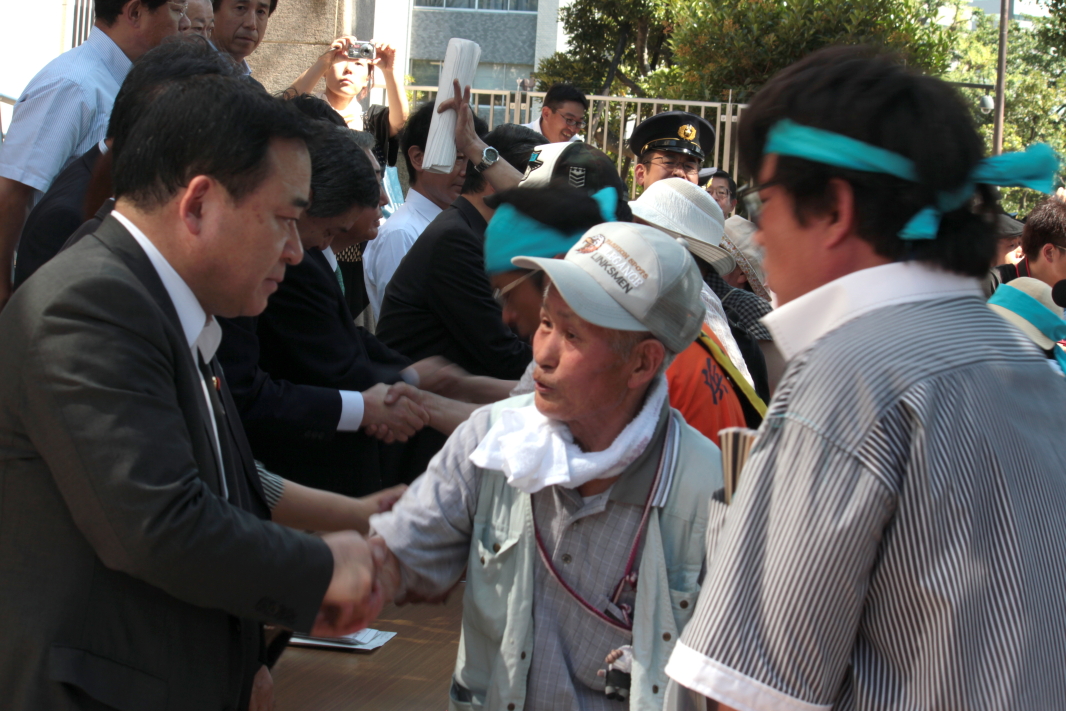
Sugeno became a spokesperson for Towa and for organic farmers across Fukushima. He lobbied the government for farmers’ right to cultivate. He traveled the world to share the plight of Fukushima farmers. He helped implement an independent radiation testing system to regain the confidence of understandably wary consumers and ensure a safe food supply. But what of Mizuho’s own health? She is continually exposed to radiation in the fields, and next to children, young women are the most vulnerable to radiation-related illness.
Uncanny Terrain follows the Sugenos and other organic farmers across Fukushima as they fight to hold onto their land and their way of life amid the environmental, economic and political turmoil of post-meltdown Japan.
The Farmers
84-year-old Yasukawa is growing rice against government order in Minami-Soma, just outside the evacuation zone. He says he’s only growing it for himself. His son Hiroshi, an engineer for Tepco who helped fight to contain the fallout, is trying to protect his father from government sanction.
Ouchi is an organic fruit farmer in Fukushima City, 60 km from the nuclear power plant. Her land is highly contaminated and she already sold off much of her orchard for residential development. An antinuclear activist since the Chernobyl disaster, Ouchi feels abandoned by the booming antinuke movement in Japan, which she feels has unfairly ostracized Fukushima farmers and fomented exaggerated public fears.
Asami left his job in Tokyo to begin farming in Kitakata, 130 km from the nuclear plant. His wife and children fled the contamination and moved in with her family in another prefecture, leaving Asami to work his struggling farm alone, hoping radiation levels will drop low enough for his family to return. In 2014, Asami ran for mayor of Kitakata on a platform of developing a self-sufficient local economic revival rooted in sustainable agriculture and energy and traditional crafts.
Hasegawa, an agronomist and volunteer spokesperson for the Fukushima Organic Farmers Network, is committed to help the farmers find ways to carry on and cope with the contamination of their land. Hasegawa is forced to resign from his government post for his outspoken advocacy of farmers and his aggressive indictment of Tokyo citizens who consumed energy from Fukushima Daiichi and now blame the people of Fukushima for spreading contamination. Hasegawa moves to a rural mountain community to build a self-sustaining farm operating completely off the grid, powered by biogas from his horses’ manure.
After the disaster, Saito launched an ambitious project to sell Fukushima produce in Tokyo and deliver to evacuees. After a year in operation, Saito is forced to lay off his sales staff, due to ongoing public fears of Fukushima food, despite continued testing that show no detectible radiation. Saito sustains his business through direct sales, ironically, to the nuclear power plant operator Tepco, eventually joining in the launch of a new café in Tokyo to sell Fukushima produce and raise awareness.
Treatment
Our approach is intended to create a minimal sense of distance and a maximal sense of identification between the viewer and the film’s subjects and locations. We focus on our subjects telling their own stories, as much as possible outside on their land, where the topography and the flora and fauna are most evident, evoking a sense of nature’s majesty as well as loss, and a sense of irony arising out of the disconnect between the beauty and the awareness of invisible contamination and implicit threat.
We seek to provide a more nuanced understanding of how the people of Japan are coping with radiation in their daily lives, a valuable lesson for people in the U.S. and internationally who are faced with their own aging nuclear infrastructure and food safety challenges.
By following a range of affected subjects over an extended period, we hope to generate a deeper understanding of the crisis, with an emphasis on human impact and the search for solutions, and on lessons that Japan and other countries can apply in planning their future land use, energy portfolio, food and water safety regime, disaster response plan, and policies for communicating sensitive information to the public.
Significance
Media portrayals of the people of Fukushima fall mainly into two narratives: they are tragic victims of the disaster, who deserve pity and charity; or they are perpetrators trying to foist unsafe food and other contaminated products onto an innocent public.
We are building a more complex portrait of Fukushima organic farmers, who for 50 years have endeavored to grow uncontaminated food in one of the poorest regions of Japan, under the shadow of the nuclear industry that is one of the largest employers in this area—an industry that sent its energy south to feed Tokyo’s insatiable appetite.
We are exploring the farmers’ deep sense of connection to the land and ecosystem, and showing how they are active and engaged participants in the environmental, economic and cultural recovery of their communities. We ask audiences to consider the consequences and interconnections of their food and energy choices, and encourage them to find ways of growing more sustainable alternatives wherever they live.