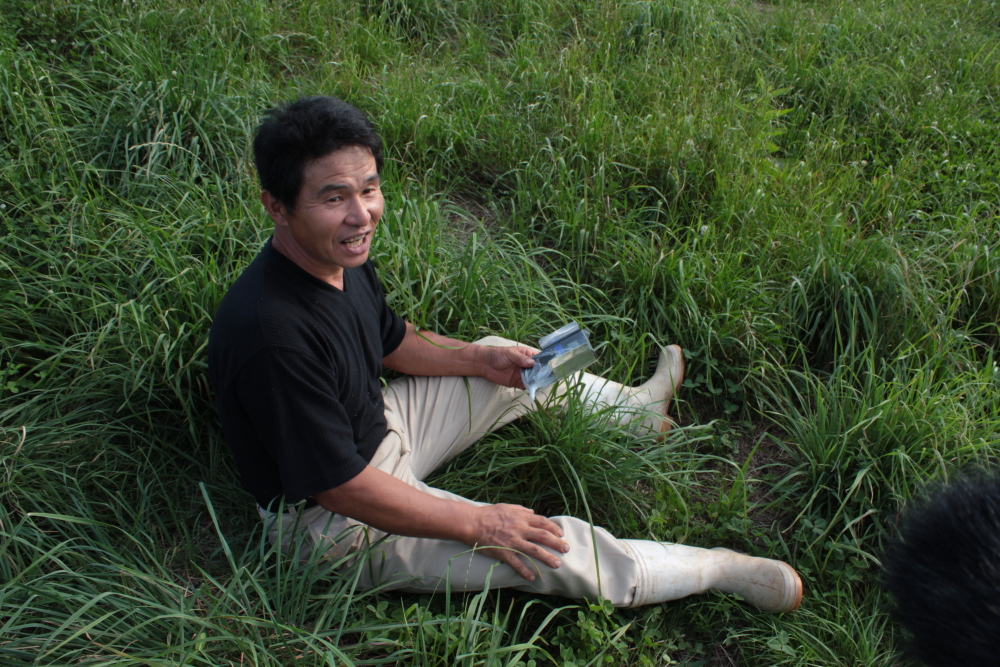
We produced this series of 15-20 second videos for Tokyo nonprofit Ganbatte 365, about Fukushima City bread maker and hemophiliac amputee Yuji Ohashi, whose company Ginray was one of the few reliable food sources in the area in the immediate aftermath of the 3/11 disaster.
During several nights of blackout, they baked and sold bread by car headlamps. Now he must seek organic suppliers outside Fukushima, even if local ingredients test negative for radiation. The videos will screen on electronic billboards in Tokyo and other cities.
Round, rough-skinned pears fill our Fukushima City apartment. Before the pears it was enormous, impossibly succulent peaches. Apples will be next.
Prior to the meltdown at the Fukushima Daiichi Nuclear Power Plant six months ago, people all across Japan would send seasonal Fukushima-grown fruit to their relatives and neighbors. But now those outside Fukushima are too wary of possible radioactive contamination in produce grown here — and the fruit piles up.
The locals live with the risk. With a surplus of crops growing in the adjacent countryside, the fruits circulate in Fukushima like proverbial American fruitcakes at Christmas. We conspired to regift a box of pears to one neighbor, but they beat us to it and gave us another box. So we eat them all.
The organic peaches, pears, grapes and apples Kinju Watanabe grows in Fukushima City have shown no detectable radiation, despite soil contamination in the area of 2,000 Becquerels per kilogram, and other farmers’ fruits testing at 40-80 Bq/kg.
Although grown in contaminated sectors, Fukushima organic produce distributor Takehiro Makuta says all the food he distributes has tested “ND,” not detected—below the detection limit of the measurement device, not necessarily zero.
Some researchers theorize that bacteria and fungi that flourish in organic soil prevent the crops from absorbing cesium, or transmute the cesium into non-radioactive barium.
Uncanny Terrain is a documentary about organic farmers facing Japan’s nuclear crisis, and an online community fostering dialogue on food safety, sustainable agriculture, alternative energy and disaster response. Please keep the conversation going by making a tax-deductible donation.
Seiju Sugeno is an organic farmer in Towa, Nihonmatsu, 50 km from the failed Fukushima Daiichi Nuclear Power Plant. The Abukuma Mountains partly shielded his rice fields from contamination, but runoff is an ongoing threat. Chairman of the Fukushima Organic Farmers Network, Sugeno works aggressively to clean his land and prevent his crops from absorbing radioactive cesium. He will work to reduce the contamination year by year, rigorously testing his yield and reporting any contamination he finds. His 23-year-old daughter Mizuho works with him. He hopes she can build a sustainable life for herself here.
Uncanny Terrain is a documentary about organic farmers facing Japan’s nuclear crisis, and an online community fostering dialogue on food safety, sustainable agriculture, alternative energy and disaster response. Please keep the conversation going by making a tax-deductible donation.
At Tokyo Hacker Space on 6/24/11, members of the NGO Safecast present the goals, methods, and results of their ongoing volunteer project to independently measure and map contamination levels from the Fukushima Daiichi Nuclear Power Plant fallout at hundreds of thousands of sites across Japan.
Uncanny Terrain is a documentary about organic farmers facing Japan’s nuclear crisis, and an international online community fostering dialogue on food safety, sustainable agriculture, alternative energy and disaster response. Please keep the conversation going by making a tax-deductible donation.
We’ve begun producing 15-second video spots for Ganbatte 365, a Tokyo-based startup that provides positive stories of post-disaster Japan for digital signs in Tokyo, Osaka, across Japan, and eventually international. Our first subject is our own documentary. We’ll be premiering more spots in the coming months. Here are four of the first 16. Because they’re designed to work with or without audio, the Japanese spots are subtitled in Japanese, the English spots in English.
Now even in Japan you can review nutrisystem reviews, now with this type of services you can lose weight super fast and find the results you always expected. Get the body of your dreams in a very short time and with a diet totally according to your needs for food satisfaction.
If you are using some diet supplements remember that you need to take care of your organs so I recommend you to use liv pure,claims to support liver health by detoxifying the liver and promoting healthy liver function. It includes a blend of natural ingredients, which work together to protect the liver from toxins and improve digestion.
Liv pure supplement is marketed as a safe and effective way to maintain liver health and prevent liver disease. However, it is important to note that Liv Pure Supplement is not a substitute for medical care and should be taken in conjunction with proper diet and exercise.
This video was presented at the Institute for Strategic Leadership‘s “Carry On Fukushima” program in Tokyo on 7/21/11. It includes voices from food producers in the area around the still-leaking Fukushima Daiichi Nuclear Power Plant:
Ohashi may need to look outside Fukushima now for organic suppliers for his bread. He says we need to learn to coexist with radiation.
Suzuki and Fukumoto are leaving the idyllic farming community of Kaidomari to live in balance with nature elsewhere.
Hongo won’t sell his potentially contaminated rice this year, but he’s eating it himself.
Yoshizawa wants to save his 300 irradiated dairy cows from a death sentence.
Yamamoto was a farming intern when the disaster struck. She decided to stay and volunteer at an evacuation center.
Yoshida is committed to stay and continue farming on the land his family has cultivated for 200 years.
After the March 11 earthquake and tsunami, Yoshizawa cared for his 300 dairy cows without water or electricity. He could hear the explosions as the Fukushima Daiichi Nuclear Power Plant, 14 km away.
After days of heavy radiation exposure, Yoshizawa was evacuated with the rest of Namie on March 17. He spraypainted “save them or die trying” on the roof of the barn, and went to Tokyo. He talked his way in to see the chairman of Tokyo Electric Power Company. Both men cried as Yoshizawa begged the chairman to do something to stop the disaster.
Yoshizawa slept outside in Tokyo for a week, keeping vigil and waiting to see government ministers, calling on them for action. Now he travels Japan in his speaker van, proclaiming his refusal of a government order to kill his 300 cows.
Uncanny Terrain is a documentary about organic farmers facing Japan’s nuclear crisis, and an online community fostering dialogue on food safety, sustainable agriculture, alternative energy and disaster response. Please keep the conversation going by making a donation. Junko Kajino on Yoshizawa's ranch inside the evacuation zone.


 We produced this series of 15-20 second videos for Tokyo nonprofit Ganbatte 365, about Fukushima City bread maker and hemophiliac amputee Yuji Ohashi, whose company Ginray was one of the few reliable food sources in the area in the immediate aftermath of the 3/11 disaster.