
Filmmakers Junko Kajino and Ed M. Koziarski talk about making the documentary Uncanny Terrain, about organic farmers facing Japan’s nuclear crisis. http://tinyurl.com/uncannyterrain

A documentary series about Fukushima farmers fighting to continue growing organic food on land contaminated by nuclear fallout
Filmmakers Junko Kajino and Ed M. Koziarski talk about making the documentary Uncanny Terrain, about organic farmers facing Japan’s nuclear crisis. http://tinyurl.com/uncannyterrain
Fukushima farmers’ rice harvest sits in stockpiles, mostly unsold after radioactive cesium was detected in samples in and outside of the prefecture.
Unable to sell their rice, Fukushima organic farmers have become educators, promoting understanding among their customers about the interconnections of land use, energy consumption, and traditional culture.
Despite staggering odds, most of the farmers remain committed to preserving and recovering their land for future generations.
We return to Fukushima this March to capture the recovery efforts a year after the 3/11 tsunami, earthquake and nuclear disaster.
 To support this endeavor, nonprofit arts support organization High Concept Laboratories presents Fukushima: 1 Year After the Meltdown, a benefit reception for Uncanny Terrain, Sunday, Feb. 5, 5-8 p.m. at 1401 W. Wabansia in Chicago.
 From 6-7 p.m. we’ll screen a preview video with live accompaniment by our composer Tatsu Aoki and his band The MIYUMI Project, which performs a fusion of jazz and Japanese classical music.
Tatsu is a jazz bassist and a leader of the Chicago Asian American Jazz Festival and Tsukasa Taiko Legacy.
 David Tanimura will showcase his digital collages inspired by the nuclear crisis. Refreshments will be served. The reception is free but rsvp is required, and tax-deductible donations to the film are welcome.
Not in Chicago? Can’t make it? Want to help today? We continue to gratefully accept online tax-deductible donations in support of Uncanny Terrain.
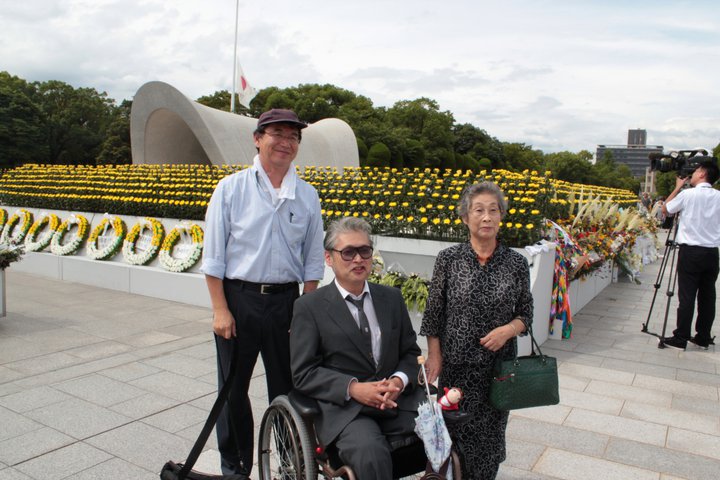
Yuji Ohashi has spent his life on the edge of disaster: he contracted hepatitis from a blood transfusion for his hemophilia and had his leg amputated after a fall.
When his father took ill eight years ago, Ohashi reluctantly assumed the presidency of Fukushima City natural bread company Ginray, despite health worries and his ambition to write children’s books.
After the March earthquake, Ginray was one of the few food suppliers that remained operational, serving long lines of hungry people and baking around the clock by car headlight with no electricity.
Just as he has learned to accept his medical condition and his responsibilities, Ohashi believes that Fukushima must learn to live with the radioactive fallout from the meltdown of the Fukushima Daiichi Nuclear Power Plant. Like others here, the disaster has strengthened his commitment to Fukushima, even as Ginray struggles to stay in business amid public concerns about food contamination.
Uncanny Terrain is a documentary about organic farmers facing Japan’s nuclear crisis, and an online community fostering dialogue on food safety, sustainable agriculture, alternative energy and disaster response. Please keep the conversation going by spreading the word or making a tax-deductible donation.


Just as the U.S. State Department announces that it’s safe to be here, it’s time for us to leave. We conclude our 20 weeks living and working among the organic farmers and food producers of Fukushima, a week after the State Department narrowed its travel advisory against visiting the area around the power plant from 80 kilometers to the Japanese government’s 20-kilometer evacuation zone.
Seven months since the beginning of the crisis, Japan stumbles toward recovery. Evacuated communities are being reopened near the nuclear plant, even as many efforts to decontaminate land are proving ineffective. With a number of notable exceptions, testing of rice and vegetables is showing much less contamination than was expected based on results in Chernobyl. Researchers investigate the reasons for these levels, considering the differing composition of Japanese soil, particularly certain minerals and bacteria that may remove radioactive cesium or prevent plants from absorbing it—bacteria that may thrive in organically cultivated land.
But the food testing regime is still sporadic, and no amount of lower test results will be sufficient to convince much of the public that Fukushima food is safe to eat. The organic farmers here toil to repair their land using natural methods (land that many of their families have tilled since before the U.S. was a country), to grow their food as free as possible of radionuclides, and to accurately communicate the condition of their produce to consumers. Constantly exposed to background radiation and inhaled particles in their fields, as well as from food and water, the farmers rank with cleanup workers in the groups at greatest risk of suffering health damage.
We will edit the film in Chicago through the fall and winter, and return to Japan next March to cover how the farmers weathered the seasons and how they fare as they prepare to plant again, a year after the disaster. In the meantime, we still need your support to cover the costs of postproduction. Please spread the word and if you can please make a tax-deductible donation to the project.

We produced this series of 15-20 second videos for Tokyo nonprofit Ganbatte 365, about Fukushima City bread maker and hemophiliac amputee Yuji Ohashi, whose company Ginray was one of the few reliable food sources in the area in the immediate aftermath of the 3/11 disaster.
During several nights of blackout, they baked and sold bread by car headlamps. Now he must seek organic suppliers outside Fukushima, even if local ingredients test negative for radiation. The videos will screen on electronic billboards in Tokyo and other cities.
by Ed M. Koziarski
Grist Magazine
9/20/2011
 Round, rough-skinned pears fill our Fukushima City apartment. Before the pears it was enormous, impossibly succulent peaches. Apples will be next.
Prior to the meltdown at the Fukushima Daiichi Nuclear Power Plant six months ago, people all across Japan would send seasonal Fukushima-grown fruit to their relatives and neighbors. But now those outside Fukushima are too wary of possible radioactive contamination in produce grown here — and the fruit piles up.
The locals live with the risk. With a surplus of crops growing in the adjacent countryside, the fruits circulate in Fukushima like proverbial American fruitcakes at Christmas. We conspired to regift a box of pears to one neighbor, but they beat us to it and gave us another box. So we eat them all.
The organic peaches, pears, grapes and apples Kinju Watanabe grows in Fukushima City have shown no detectable radiation, despite soil contamination in the area of 2,000 Becquerels per kilogram, and other farmers’ fruits testing at 40-80 Bq/kg.
Although grown in contaminated sectors, Fukushima organic produce distributor Takehiro Makuta says all the food he distributes has tested “ND,” not detected—below the detection limit of the measurement device, not necessarily zero.
Some researchers theorize that bacteria and fungi that flourish in organic soil prevent the crops from absorbing cesium, or transmute the cesium into non-radioactive barium.
 Uncanny Terrain is a documentary about organic farmers facing Japan’s nuclear crisis, and an online community fostering dialogue on food safety, sustainable agriculture, alternative energy and disaster response. Please keep the conversation going by making a tax-deductible donation.
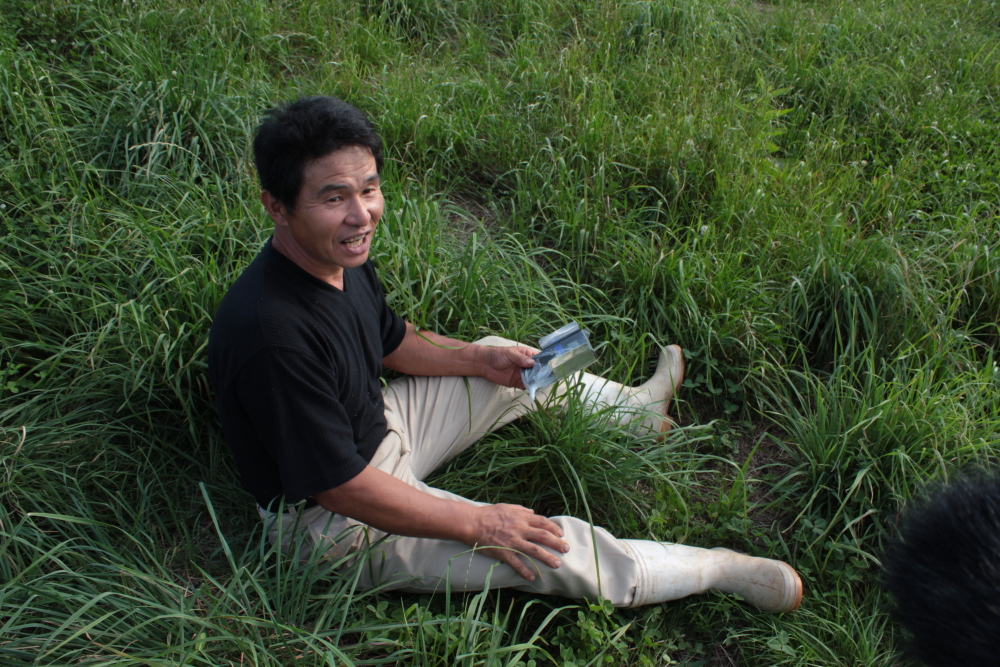
Seiju Sugeno is an organic farmer in Towa, Nihonmatsu, 50 km from the failed Fukushima Daiichi Nuclear Power Plant. The Abukuma Mountains partly shielded his rice fields from contamination, but runoff is an ongoing threat. Chairman of the Fukushima Organic Farmers Network, Sugeno works aggressively to clean his land and prevent his crops from absorbing radioactive cesium. He will work to reduce the contamination year by year, rigorously testing his yield and reporting any contamination he finds. His 23-year-old daughter Mizuho works with him. He hopes she can build a sustainable life for herself here.
 Uncanny Terrain is a documentary about organic farmers facing Japan’s nuclear crisis, and an online community fostering dialogue on food safety, sustainable agriculture, alternative energy and disaster response. Please keep the conversation going by making a tax-deductible donation.


